Your Security Policies Exist. Your Employees Have No Idea What They Are.
We’ve all been there. You create a policy, send it out in an email, maybe even get everyone to click “I agree” on a digital form. You check the box. Policy implemented. Done.
Except it’s not done. Not even close.
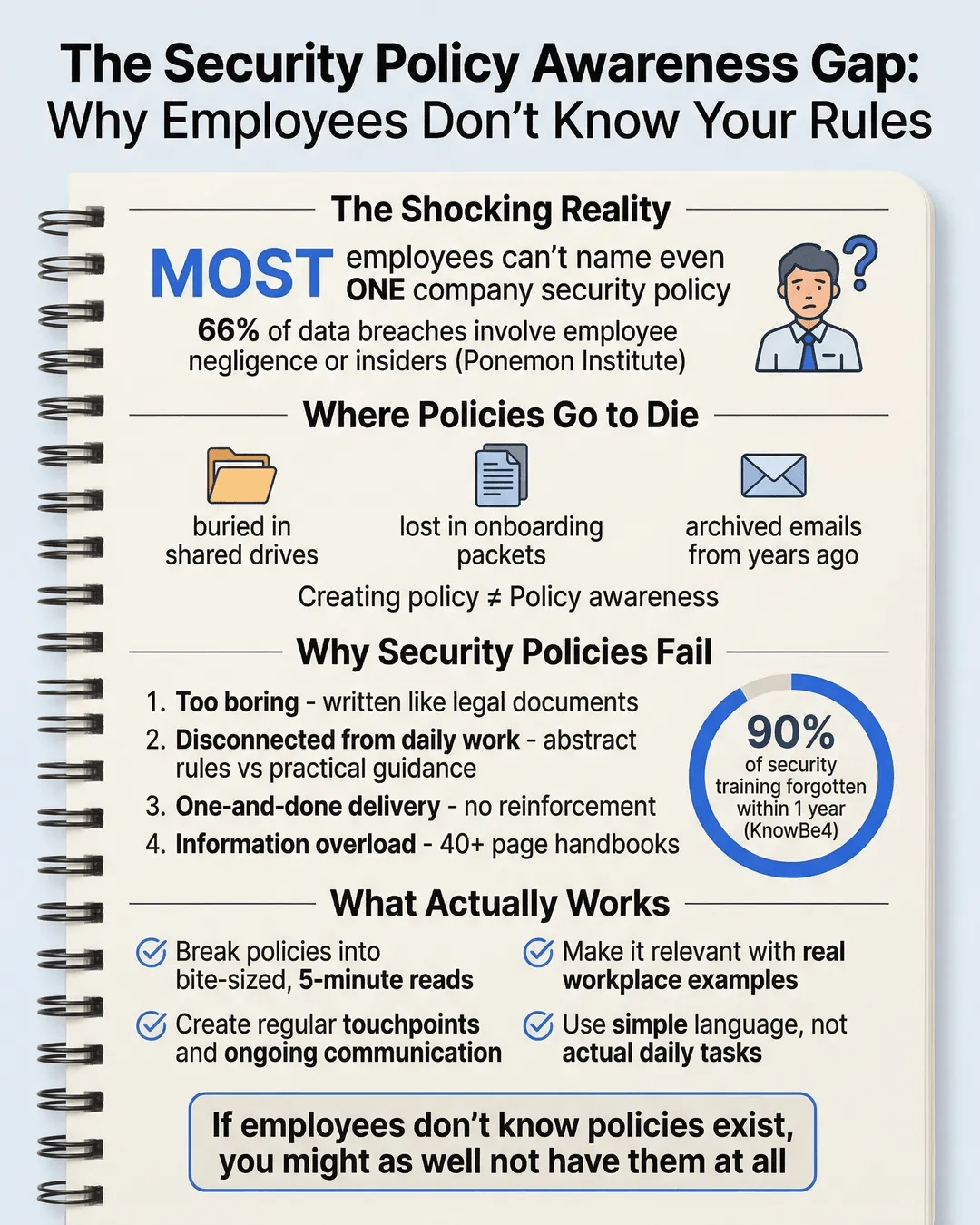
Over the past few years, we’ve asked hundreds of employees across dozens of small and mid-sized businesses a simple question: “Can you name one of your company’s security policies?” The results were eye-opening. Most couldn’t name a single one. Not one.
These weren’t careless employees. They were hardworking people who genuinely cared about their jobs. But somewhere between policy creation and actual implementation, something broke down. The gap between having a security policy and employees actually knowing what’s in it has become a silent crisis in SMB cybersecurity.
And here’s the uncomfortable truth: if your employees don’t know your security policies exist, you might as well not have them at all.
Key Takeaways
- Most employees can’t name a single company security policy, creating a dangerous gap between policy creation and awareness.
- Security policies fail when they’re treated as compliance checkboxes rather than living documents that guide daily behavior.
- Effective security awareness requires ongoing communication, practical examples, and integration into everyday workflows.
- Small and mid-sized businesses face unique challenges in security awareness due to limited resources and competing priorities.
- Making policies accessible, relevant, and reinforced through regular touchpoints dramatically improves employee understanding and compliance.
The Policy Graveyard
Let’s talk about where security policies go to die.
Most often, it’s in a shared drive somewhere. Maybe it’s buried in an onboarding packet that new hires skim through on their first day. Or it lives in an email from two years ago that everyone archived immediately after clicking the mandatory acknowledgment button.
We’ve seen companies with beautifully written security policies. Detailed guidelines on password management, data handling, acceptable use of company resources, and incident reporting procedures. These documents were crafted with care, often with help from consultants or legal teams. They covered every scenario, anticipated every risk.
And exactly zero employees could tell us what was in them.
The problem isn’t that these policies are bad. The problem is that creating a policy and ensuring people actually know about it are two completely different challenges. Most organizations nail the first one and completely miss the second.
When we dig deeper with business owners and HR leaders, we hear the same frustrations. “We sent it out.” “Everyone signed off on it.” “It’s in the employee handbook.” All technically true. All practically useless if nobody remembers what they read.
According to the Ponemon Institute, 66% of data breaches involve employee negligence or malicious insiders¹. When your team doesn’t know the rules, they can’t follow them. And that gap becomes the weakest link in your entire security infrastructure.
Why Nobody Remembers Your Policies
We need to be honest about why security policies fail to stick.
First, they’re boring. Really boring. Security policies read like legal documents because, well, they often are legal documents. They’re written in formal language, packed with jargon, and structured for compliance rather than comprehension. Nobody wants to read them, and nobody remembers what they say five minutes after closing the PDF.
Second, they’re disconnected from daily work. Most security policies are presented as abstract rules rather than practical guidance. An employee reads “Use strong passwords and enable multi-factor authentication” but doesn’t connect that to the actual moment when they’re creating a new account or accessing a client database. The policy exists in one world, their work exists in another.
Third, they’re one-and-done. You get the policy during onboarding or in an annual email blast, and then it disappears from your radar completely. There’s no reinforcement, no reminders, no ongoing conversation. By the time a situation arises where the policy actually matters, it’s long forgotten.
Fourth, there’s too much information dumped at once. We’ve seen employee handbooks with 40-page security sections covering everything from physical access control to social media guidelines. The human brain simply cannot retain that volume of information from a single reading. Employees nod along, sign the form, and retain almost nothing.
A study by KnowBe4 found that without reinforcement, employees forget 90% of security training content within a year². That’s not because employees are careless. That’s because we’re asking them to remember complex information they encountered once, in a format designed for lawyers, not for people trying to do their jobs.
What Actually Works
So what do we do about this?
The companies that successfully bridge the policy-awareness gap do a few things differently. They treat security policies as living documents that need constant reinforcement, not one-time announcements.
Start with simplicity. Break down your security policies into bite-sized, practical guidelines that people can actually remember. Instead of a 30-page document, create short, focused documents for specific scenarios. “How to handle customer data.” “What to do if you receive a suspicious email.” “Rules for working remotely.” Each one should be readable in under five minutes.
Make it relevant to daily work. Connect every policy to real situations your employees encounter. Don’t just say “don’t click on suspicious links.” Show examples of what suspicious emails actually look like. Walk through what happens when someone accidentally clicks. Make it concrete and specific to your industry and your workflows.
Build in regular touchpoints. Security awareness can’t be an annual event. The most effective organizations we’ve seen use monthly or quarterly reminders. Short emails. Quick team meeting discussions. Real-world examples of recent threats. Keep the conversation active so policies stay top of mind.
One mid-sized financial services firm we worked with completely transformed their approach. Instead of sending out a massive policy document once a year, they started a “Security Tip Tuesday” email series. Every Tuesday, employees got a two-minute email covering one specific aspect of their security policies with a real-world example. Six months later, when we asked employees about security policies, the change was dramatic. People could name specific policies. They could explain why they mattered. They actually changed their behavior.
Another company integrated security policy reminders into their existing tools. When employees accessed sensitive customer data, a brief popup reminded them of the relevant data handling policy. When someone tried to share a file externally, a quick reminder about data classification appeared. The policies showed up exactly when and where they were relevant.
Use stories and examples. Humans remember stories far better than rules. Share real incidents (anonymized if necessary) where following or ignoring a policy made a difference. “Last month, an employee received an email that looked like it was from our CEO requesting a wire transfer. They remembered our verification policy and called to confirm before acting. That policy prevented a $50,000 loss.” That sticks in people’s minds.
Get leadership involved. When executives talk about security policies in team meetings, reference them in decisions, and visibly follow them, it signals that these aren’t just HR requirements. They’re actual priorities that matter to the business.
The SMB Challenge
Small and mid-sized businesses face unique challenges here. You don’t have a dedicated security team. You don’t have a training department. You’re already stretched thin across every function.
But that doesn’t mean security awareness is impossible. It means you need to be smart about it.
Start with the basics. Focus on the three to five security policies that matter most for your business. Maybe it’s password management, phishing awareness, and data handling. Don’t try to cover everything at once. Build competency in the fundamentals first.
Leverage free resources. Organizations like the National Institute of Standards and Technology (NIST) and the Cybersecurity and Infrastructure Security Agency (CISA) offer free security awareness materials designed for small businesses³. You don’t need to create everything from scratch.
Make it part of existing meetings. You probably already have team meetings or all-hands calls. Add a five-minute security moment to the agenda. Rotate who presents it. Make it conversational, not preachy.
Use your existing communication channels. If you have a company newsletter, include a security tip. If you use Slack or Teams, create a security channel where you share quick updates. Meet people where they already are.
The Verizon Data Breach Investigations Report found that 43% of data breaches involve small businesses⁴. You’re a target whether you think you are or not. And your best defense isn’t expensive technology. It’s informed employees who know what to do when something looks wrong.
Making It Stick
The goal isn’t perfect compliance. The goal is building a culture where security awareness becomes second nature.
That happens through repetition, relevance, and reinforcement. Say the same core messages in different ways, at different times, through different channels. Connect every policy to why it matters for your specific business and your employees’ daily work. Reinforce positive behavior when you see people following policies.
Test understanding in low-stakes ways. Send out a fake phishing email and see who reports it. Ask people what they’d do in a hypothetical scenario during a team meeting. Use the results not to punish but to identify where more clarity is needed.
Celebrate wins. When someone spots a threat and reports it, recognize them. When your team goes a quarter without a security incident, acknowledge it. Make following security policies something people feel good about, not just something they’re obligated to do.
Update policies based on real feedback. If employees consistently struggle with a particular policy, the policy might be the problem. Ask what’s confusing. Ask what would make it easier to follow. Your policies should serve your business, not the other way around.
We’ve worked with businesses that went from zero security awareness to having employees proactively identify and report threats within six months. It didn’t require massive budgets or dedicated staff. It required consistent effort, clear communication, and a genuine commitment to making security policies something people could actually understand and use.
Conclusion
Creating security policies is the easy part. Getting employees to know, understand, and actually follow them is where the real work begins.
If you walked around your office right now and asked people to name one security policy, what would they say? If the answer is “nothing” or “I’m not sure,” you have a gap to close. And that gap represents real risk.
The good news is that closing it doesn’t require a complete overhaul of your security program. It requires consistent communication, practical examples, and a shift from treating policies as compliance documents to treating them as tools that help people work safely.
Your security policies can’t protect your business if they’re sitting unread in a shared drive. Make them visible. Make them relevant. Make them part of the everyday conversation. Because the best policy in the world is worthless if nobody knows it exists.
Citations
- Ponemon Institute, “Cost of Insider Threats Global Report,” 2024.
- KnowBe4, “Security Awareness Training Effectiveness Study,” 2024.
- National Institute of Standards and Technology (NIST), “Small Business Cybersecurity Resources,” 2024.
- Verizon, “Data Breach Investigations Report,” 2024.