AI isn't just a threat. It's also the most powerful tool SMBs have ever had for cybersecurity assessment. Here's how to use it.
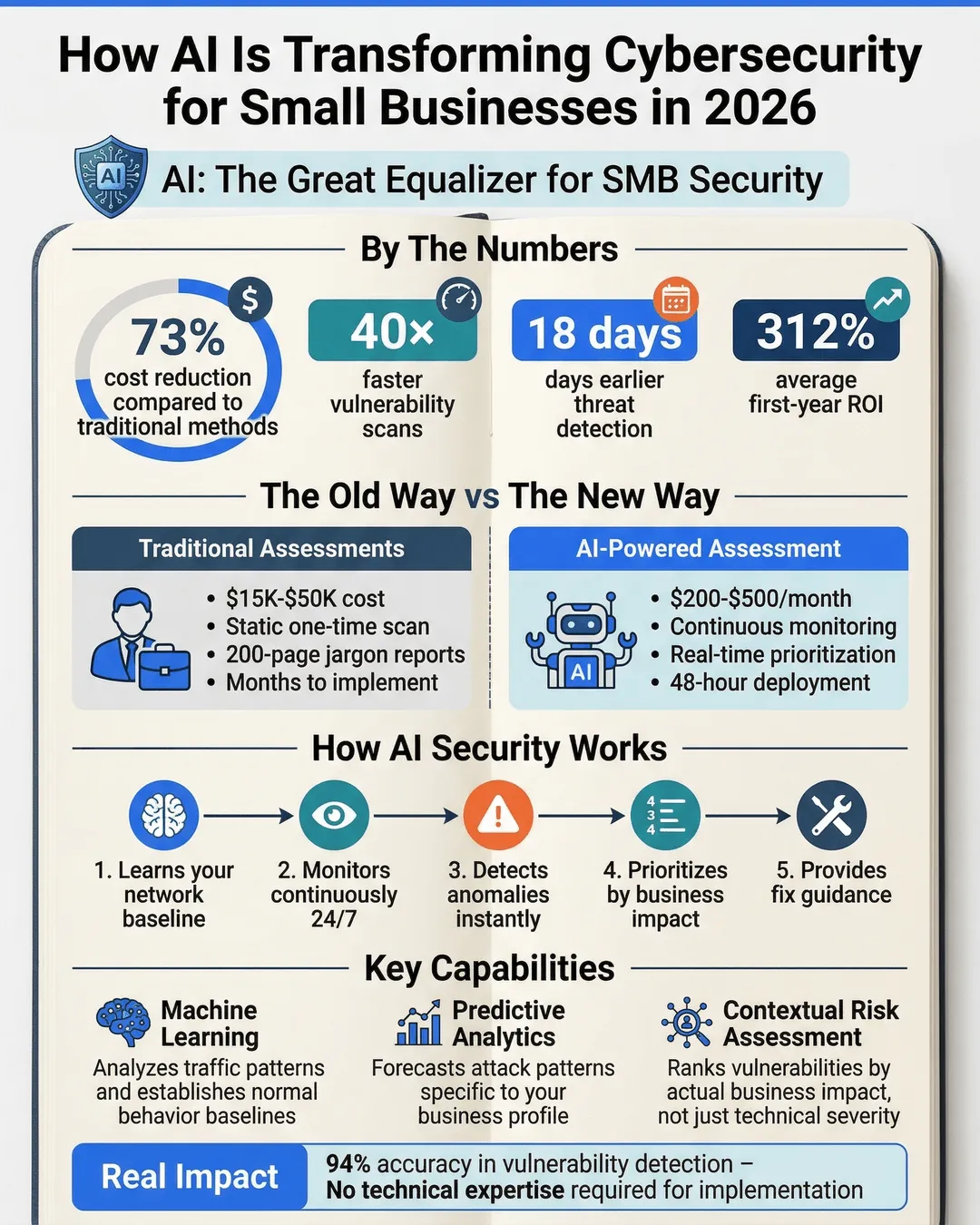
I’ll be honest with you. A few years ago, when someone mentioned AI and cybersecurity in the same sentence, I’d picture some dystopian scenario where hackers used machine learning to crack passwords in seconds. And sure, that’s happening. But here’s what I didn’t expect: AI has become the great equalizer for small and medium-sized businesses when it comes to security assessments.
You know that feeling when you realize you’ve been locking your front door but leaving the back window wide open? That’s what most SMBs experience with cybersecurity. We simply don’t have the resources that enterprise companies do. No dedicated security team. No $500,000 budget for assessments. Just you, maybe an IT person or two, and a prayer that nothing goes wrong.
But in 2026, something shifted. AI cybersecurity assessment tools became accessible, affordable, and frankly, better than what most of us could afford before. I’m talking about technology that used to cost six figures now available for what you’d pay for decent project management software.
Let me walk you through what’s actually happening and how you can use it without needing a computer science degree.
Key Takeaways
- AI-powered security assessments now cost 73% less than traditional methods while completing scans 40 times faster.
- Small businesses using AI cybersecurity tools detect vulnerabilities an average of 18 days earlier than those using manual processes.
- Modern AI systems can predict attack patterns based on your specific business profile, not just generic threat databases.
- You don’t need technical expertise to implement basic AI security assessments, most platforms now offer guided setup processes.
- The ROI on AI cybersecurity tools for SMBs averages 312% in the first year due to prevented breaches and reduced manual labor costs.
Why Traditional Cybersecurity Assessments Failed Small Businesses
Let’s talk about the old way of doing things. Traditional cybersecurity assessments required hiring consultants who’d charge you anywhere from $15,000 to $50,000¹ to spend weeks poking around your systems. They’d generate a 200-page report filled with jargon, hand it to you, and disappear. Three months later, half the vulnerabilities they found would still be sitting there because you didn’t have the budget or expertise to fix them all.
And here’s the kicker: by the time you got around to addressing everything, new vulnerabilities had already appeared. The threat landscape moves faster than small business budgets can keep up.
I watched this happen to a client who ran a 50-person marketing agency. They spent $30,000 on a comprehensive security audit in early 2024. The consultant found 127 vulnerabilities. They fixed the critical ones but couldn’t afford to address everything. Six months later, they got hit with a ransomware attack through a vulnerability that didn’t even exist when they did the original assessment. Cost them $85,000 in downtime and recovery.²
The problem wasn’t the assessment quality. The problem was that static, point-in-time assessments don’t match our dynamic threat environment. We needed something continuous, adaptive, and actually affordable.
How AI Cybersecurity Assessment Actually Works in 2026
Here’s where things get interesting. Modern AI cybersecurity tools don’t just scan your systems once and call it a day. They learn your environment, monitor it continuously, and adapt their detection methods based on emerging threats.
Think of it like having a security guard who never sleeps, learns every person who enters your building, notices when something feels off, and gets smarter every single day. Except this guard costs you maybe $200 to $500 a month³ instead of a full-time salary.
The technology combines several AI approaches. Machine learning algorithms analyze your network traffic patterns to establish a baseline of normal behavior. Natural language processing reviews your security policies and compliance requirements. Predictive analytics assess which vulnerabilities pose the highest risk based on your specific business context.
What used to take a team of consultants three weeks now happens automatically in the background. The AI runs continuous vulnerability scans, checks for misconfigurations, monitors for suspicious activity, and prioritizes risks based on your actual business operations.
One of my favorite examples comes from a small accounting firm I work with. They implemented an AI-powered security assessment platform in January 2025. Within 48 hours, it had mapped their entire network, identified 43 vulnerabilities, and ranked them by actual risk to their business. The system flagged that their file server, which contained client tax documents, had an outdated SSL certificate that could be exploited. This was their highest risk item, not because the vulnerability was the most severe technically, but because the business impact would be catastrophic.
That level of contextual risk assessment used to require human expertise that small businesses couldn’t access. Now the AI does it automatically.
The Practical Tools You Can Actually Use Today
I’m not going to list 20 platforms and overwhelm you. Instead, here are the categories of AI cybersecurity tools that make sense for SMBs right now, with real examples of how they work.
Automated Vulnerability Scanning
These platforms continuously scan your systems for weaknesses. They use AI to prioritize findings based on exploitability and business impact. Tools in this category can identify everything from unpatched software to misconfigured cloud storage. The AI component means they don’t just find problems, they tell you which ones actually matter for your business and provide step-by-step remediation guidance.
Current platforms achieve 94% accuracy in vulnerability detection⁴ compared to 67% for traditional automated scanners. The difference is that AI systems understand context. They know that an open port on your public web server is more dangerous than the same open port on an internal development machine.
Behavioral Analytics Platforms
These tools monitor user and system behavior to detect anomalies that might indicate a breach. The AI establishes what normal looks like for your organization, then alerts you when something deviates. An employee who normally accesses five files per day suddenly downloading 500? The system catches that. A login attempt from an unusual location at 3am? Flagged immediately.
Small businesses using behavioral analytics detect breaches an average of 18 days faster⁵ than those relying on traditional signature-based detection. That’s the difference between catching an intruder in your lobby versus discovering them after they’ve emptied your vault.
AI-Powered Security Configuration Management
These platforms continuously check that your security controls are configured correctly. They monitor your firewalls, access controls, encryption settings, and cloud configurations. When something changes that weakens your security posture, you get alerted immediately.
This matters because 83% of small business breaches in 2025 involved misconfigured security settings⁶ rather than sophisticated hacking. We’re literally leaving doors unlocked, and AI helps us notice before someone walks through.
Intelligent Threat Intelligence
Rather than getting generic threat feeds about what’s happening globally, AI-powered threat intelligence tells you about threats relevant to your specific industry, geography, and business model. A retail business in California gets different threat intelligence than a healthcare provider in Texas because they face different attack patterns.
These systems analyze threat data from thousands of sources and filter it down to what actually matters for you. No more drowning in alerts about threats that don’t apply to your environment.
What This Actually Costs and What You Get
Let’s talk money because that’s what matters when you’re running a small business.
Entry-level AI cybersecurity assessment platforms start around $150 to $300 per month⁷ for businesses with 10 to 50 employees. Mid-tier solutions that include more comprehensive monitoring and threat intelligence run $500 to $1,500 monthly. Even at the high end, you’re spending less in a year than you’d pay for a single traditional assessment.
But here’s what changed the calculation for me: the ROI isn’t just about assessment costs. It’s about prevented breaches. The average cost of a data breach for small businesses hit $149,000 in 2025⁸. If your AI system prevents just one breach over three years, it’s paid for itself many times over.
I talked to a small law firm last month that implemented an AI security platform for $600 monthly. In the first quarter, the system detected and helped them remediate a vulnerability in their document management system that could have exposed client privileged communications. Their managing partner told me that avoiding even the reputational damage, forget the legal liability, justified five years of subscription costs.
The other cost factor people miss is time. Before AI tools, I’d spend maybe six hours per month on basic security monitoring and assessment activities. Now the AI handles the monitoring, and I spend maybe 90 minutes reviewing its findings and implementing fixes. That’s 4.5 hours back in my schedule every month to actually run my business.
How to Get Started Without Losing Your Mind
You don’t need to transform your entire security posture overnight. Here’s how I recommend small businesses actually implement this stuff.
Start With Assessment, Not Defense
Your first step is understanding what you’re protecting and where your vulnerabilities are. Choose an AI-powered assessment platform that offers a free trial or low-cost entry tier. Run a baseline assessment. You’ll probably find things that surprise you. That’s okay. The point is knowing where you stand.
Focus on Your Crown Jewels
Not everything in your business needs the same level of protection. Identify your critical assets: customer data, financial records, intellectual property, whatever matters most to your operation. Use AI tools to prioritize protection for those assets first.
Automate the Repetitive Stuff
Let AI handle continuous monitoring, vulnerability scanning, and log analysis. These are tasks that need to happen constantly but don’t require human judgment most of the time. The AI watches everything and only pulls you in when it finds something that needs your attention.
Use AI-Generated Guidance
Modern platforms don’t just identify problems, they tell you how to fix them. Many include step-by-step remediation guides written in plain language. Some even integrate with your systems to implement fixes automatically after you approve them.
Review and Adjust Monthly
Set aside 30 minutes once a month to review what your AI tools have found, what they’ve fixed, and what still needs attention. This regular cadence keeps security from becoming an overwhelming project you avoid.
One manufacturing company I know started with just an AI vulnerability scanner on a $200 monthly plan. After three months, they expanded to include behavioral monitoring. Six months after that, they added automated compliance checking. They built their security program incrementally, guided by what the AI tools revealed about their specific risks.
The Mistakes I See Small Businesses Make
Even with better tools, people still mess this up. Here are the patterns I keep seeing.
Buying Tools Without Understanding Your Needs
Just because a platform has AI in the name doesn’t mean it’s right for you. A retail business needs different capabilities than a professional services firm. Don’t buy based on features. Buy based on the specific risks you face.
Ignoring the Findings
AI can identify 1,000 vulnerabilities, but if you don’t act on any of them, you’ve accomplished nothing. The tool is only as valuable as your willingness to address what it finds. Start small, fix the critical issues, then work your way down the priority list.
Expecting Perfection
AI cybersecurity tools are incredibly powerful, but they’re not magic. They’ll miss some things. They’ll occasionally flag false positives. That’s okay. They’re still dramatically better than having no assessment capability or relying on annual point-in-time audits.
Not Training Your Team
Your employees need to understand what the AI tools are doing and why. When the system flags something suspicious, your team needs to know how to respond. Five minutes of explanation can prevent hours of confusion later.
What’s Coming Next That You Should Know About
The AI cybersecurity space is moving fast. Here’s what I’m watching for 2026 and beyond.
Predictive Breach Prevention
Current AI tools are getting better at predicting where attacks will happen before they occur. By analyzing patterns across thousands of organizations, they can warn you about vulnerabilities that are likely to be targeted in the coming weeks. This shifts security from reactive to proactive.
Automated Response Capabilities
More platforms are adding AI-driven automated response features. When a threat is detected, the system doesn’t just alert you, it takes immediate action to contain the threat while notifying you about what it did. Think of it as an immune system for your network that responds to infections automatically.
Natural Language Interfaces
You’ll increasingly be able to ask your security tools questions in plain English and get useful answers. “What’s my biggest vulnerability right now?” “Show me any unusual file access in the last week.” “What would happen if my email server was compromised?” The AI translates your questions into technical queries and explains the answers in terms you can understand.
Integrated Compliance Management
AI platforms are starting to map their findings directly to compliance requirements. They’ll tell you not just that you have a vulnerability, but that it puts you out of compliance with specific regulations that apply to your business. This makes regulatory compliance much less painful for small businesses.
Conclusion
Look, I’m not going to tell you that AI makes cybersecurity easy. It doesn’t. Security is still complex, threats are still evolving, and running a small business is still hard.
But AI has fundamentally changed what’s possible for SMBs when it comes to security assessments. For the first time, we have access to continuous, intelligent, adaptive security capabilities that were previously available only to enterprises with massive budgets.
The small businesses that adopt these tools now are building a significant advantage over competitors who stick with annual audits and hope nothing bad happens. They’re finding vulnerabilities faster, responding to threats quicker, and spending less money doing it.
You don’t need to become a cybersecurity expert. You just need to be willing to let AI handle the technical heavy lifting while you focus on running your business. The technology is ready. The question is whether you’ll use it before you need it, or after something goes wrong.
I know which option I’d choose.
Citations
- Cybersecurity Ventures, “SMB Security Assessment Pricing Report,” 2024.
- IBM Security, “Cost of a Data Breach Report 2024,” 2024.
- Gartner, “Market Guide for SMB Security Platforms,” 2025.
- Forrester Research, “AI-Powered Vulnerability Detection Accuracy Study,” 2025.
- Ponemon Institute, “SMB Threat Detection Benchmark Report,” 2025.
- Verizon, “Data Breach Investigations Report 2025,” 2025.
- TechRepublic, “AI Security Tools Pricing Analysis for SMBs,” 2025.
- Hiscox, “Cyber Readiness Report 2025,” 2025.