Cyberattacks are more expensive than prevention, but most SMBs keep learning this lesson the hard way. It's time to flip the script.
I talk to business owners every day who’ve just experienced their first major security breach. The conversation always follows the same pattern. First comes the shock. Then the anger. Finally, the dreaded question: “How much is this going to cost us?”
The answer is never good.
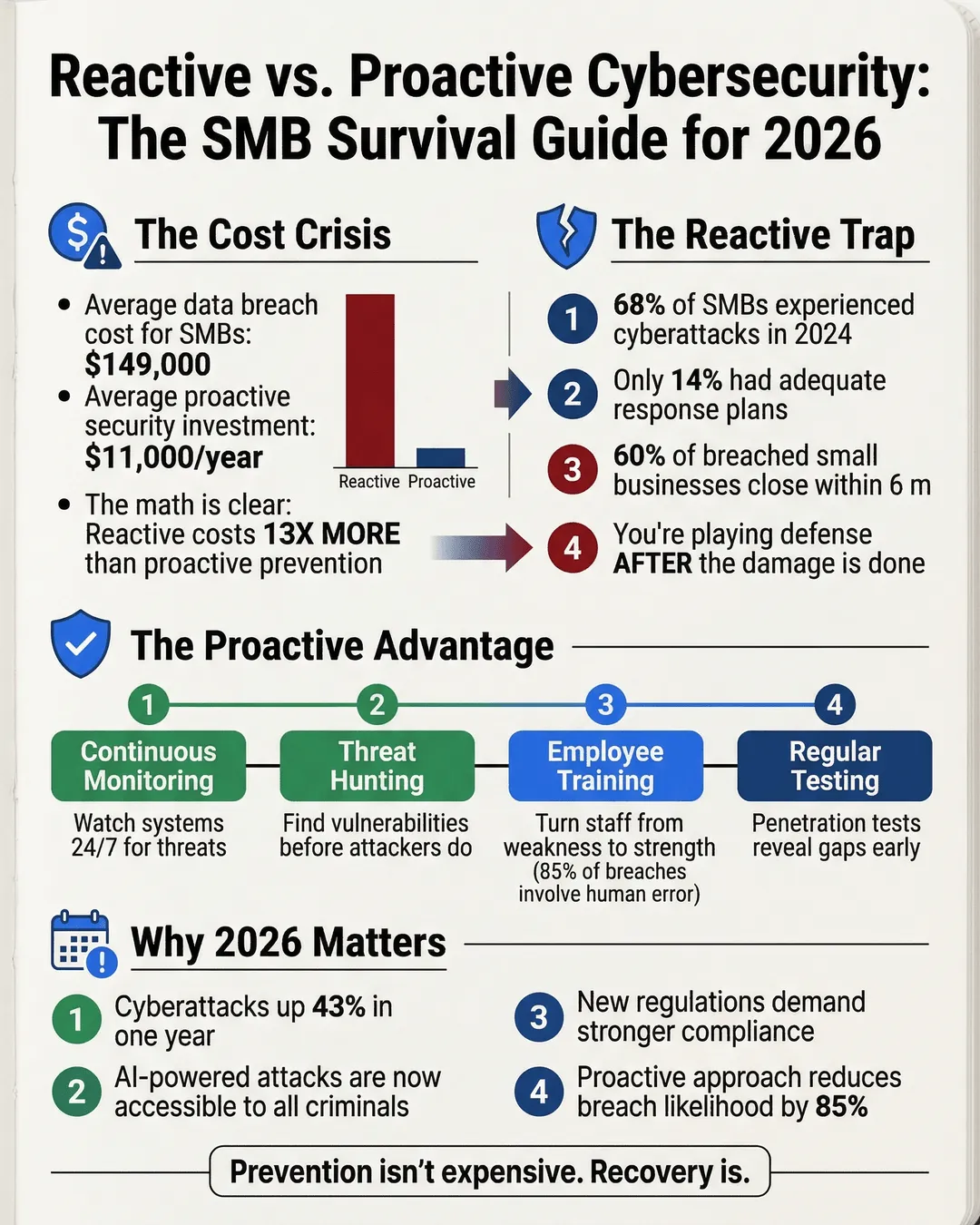
Here’s what most small and medium-sized businesses don’t realize until it’s too late: the average cost of a data breach for SMBs hit $149,000 in 2024¹. For many companies, that’s a business-ending figure. But here’s the kicker. The average annual investment in proactive cybersecurity? Around $11,000².
You don’t need an MBA to see the problem with that math.
Most SMBs operate on what I call the “wait and see” approach to security. They implement basic protections, hope nothing bad happens, and scramble to respond when something eventually does. It’s reactive cybersecurity, and it’s quietly killing businesses across every industry.
The good news? You can change your approach before you become another cautionary tale.
Key Takeaways
- Reactive cybersecurity costs SMBs an average of 13 times more than proactive prevention strategies.
- 60% of small businesses that experience a major cyberattack close within six months.
- Proactive cybersecurity strategy for SMBs includes threat hunting, employee training, and continuous monitoring rather than just responding to incidents.
- The shift from reactive to proactive security requires cultural change, not just technology upgrades.
- A preventive cybersecurity approach reduces breach likelihood by up to 85% according to 2025 industry data.
What Reactive Cybersecurity Actually Looks Like (And Why It Fails)
Let me paint you a picture of reactive security in action.
Your employee clicks a phishing link. Malware spreads across your network. You don’t notice anything wrong for days, maybe weeks. By the time your systems start acting strange, the damage is done. Customer data has been exfiltrated. Ransomware has encrypted critical files. Your operations grind to a halt.
Now you’re in crisis mode. You call an emergency IT response team. You notify affected customers. You deal with regulatory compliance issues. You potentially face lawsuits. Your reputation takes a hit that lasts for years.
This is reactive cybersecurity. You wait for something bad to happen, then you respond.
The fundamental problem with this approach is simple. By the time you’re responding, you’ve already lost. The breach happened. The data left your systems. The trust eroded.
Reactive strategies focus on damage control, not damage prevention. You’re essentially playing defense after the other team has already scored. And in cybersecurity, unlike sports, you rarely get a chance to come back from behind.
The statistics back this up. Research shows that 68% of SMBs experienced at least one cyberattack in 2024³. Of those, only 14% had adequate incident response plans in place⁴. The rest scrambled to figure things out while their businesses bled money and reputation.
But the really troubling part? Most of these attacks were entirely preventable with proactive measures.
The Proactive Cybersecurity Mindset: Prevention Over Reaction
Proactive cybersecurity flips the entire script. Instead of waiting for attacks and responding to breaches, you actively work to prevent them from happening in the first place.
Think of it this way. Reactive security is like only going to the doctor when you’re already sick. Proactive security is getting regular checkups, eating well, exercising, and catching problems before they become serious.
A preventive cybersecurity approach includes several core components that work together.
First, continuous monitoring. You’re not just checking your systems occasionally. You’re watching them constantly for suspicious activity. Unusual login attempts from strange locations? You catch it immediately. Strange data transfers at 3 AM? You’re alerted before significant damage occurs.
Second, threat hunting. This means actively looking for vulnerabilities and potential attack vectors before bad actors find them. You’re testing your own defenses, identifying weak points, and patching them proactively.
Third, employee education. This is huge. Your team isn’t just told “don’t click suspicious links” once a year. They receive ongoing, engaging training that turns them from your biggest vulnerability into your strongest defense layer. Because here’s the truth: 85% of breaches involve a human element⁵.
Fourth, regular security assessments and penetration testing. You bring in experts to try breaking into your systems so you can fix issues before real attackers exploit them.
Sarah Chen, CISO at SecureSmall Inc., puts it perfectly: “Proactive cybersecurity isn’t about having perfect defenses. It’s about knowing your weaknesses before attackers do and continuously improving your security posture.”
The shift from reactive to proactive security also changes how you think about your security budget. Instead of viewing it as an expense you minimize, you see it as insurance that actually prevents claims rather than just paying them out.
Why 2026 Is the Year SMBs Must Make This Shift
You might be thinking, “This all sounds great, but why now? Why is 2026 the critical year?”
Fair question. Let me break down what’s changed and what’s coming.
First, the threat landscape has evolved dramatically. Cyberattacks against SMBs increased 43% between 2023 and 2024⁶. But it’s not just the volume. The sophistication has skyrocketed. Thanks to AI-powered attack tools, even unsophisticated criminals can launch advanced attacks. The barrier to entry for cybercrime has never been lower.
Second, regulatory requirements are tightening. New data protection laws rolled out in 2025 place significantly higher compliance burdens on businesses of all sizes. The days of SMBs flying under the regulatory radar are over. You’re now held to many of the same standards as enterprise companies, with penalties that can cripple a small business.
Third, cyber insurance has fundamentally changed. Insurers now require proof of proactive security measures before they’ll even offer coverage. Basic reactive measures like antivirus and firewalls? Not enough anymore. Insurers want to see employee training programs, incident response plans, regular security assessments, and multi-factor authentication across your organization.
Fourth, customer expectations have shifted. Your clients, especially if you’re in B2B, now ask detailed questions about your security practices before signing contracts. They want assurance that partnering with you won’t put their data at risk. A reactive approach doesn’t cut it anymore.
Michael Torres, CEO of a regional accounting firm, shared his experience with me: “We lost three major prospects in 2024 because we couldn’t demonstrate adequate security measures during their vendor assessments. That was our wake-up call. We implemented a proactive cybersecurity strategy and now it’s actually a competitive advantage.”
The final reason 2026 matters? The cost differential keeps growing. As attacks become more sophisticated and costly, while proactive tools become more accessible and affordable, the gap between prevention costs and breach costs widens every year.
Waiting another year means rolling the dice with increasingly unfavorable odds.
Building Your Proactive Cybersecurity Strategy (Without Breaking the Bank)
Here’s where most SMB leaders get stuck. You understand the need for proactive cybersecurity. You want to make the shift. But you look at enterprise security solutions with five-figure monthly price tags and think, “We can’t afford this.”
I get it. But here’s what you need to know. A proactive cybersecurity strategy for SMBs doesn’t require an enterprise budget. It requires smart prioritization and a commitment to consistent action.
Start with the fundamentals that deliver the biggest impact.
Implement comprehensive employee security awareness training. This is your highest ROI move. Quality training programs cost between $20-50 per employee annually⁷. For that investment, you dramatically reduce your biggest vulnerability. Make it engaging, not just another boring compliance video. Use real-world scenarios. Test your team with simulated phishing campaigns. Celebrate people who spot and report suspicious activity.
Deploy multi-factor authentication everywhere. Not just on email. On every system that contains sensitive data or controls critical functions. This single step blocks 99.9% of automated account takeover attempts⁸.
Establish continuous monitoring with modern security tools. You don’t need a 24/7 security operations center. Managed detection and response services now offer SMB-focused packages starting around $500 monthly. They provide enterprise-grade monitoring at a fraction of the cost of building it yourself.
Conduct regular vulnerability assessments. Quarterly scans of your systems and network identify weaknesses before attackers do. Many quality vulnerability scanning tools offer plans under $200 monthly for small networks.
Create and actually test your incident response plan. Most SMBs have some sort of plan in a document somewhere. Almost none have tested it. Run tabletop exercises where your team walks through breach scenarios. Update the plan based on what you learn. This costs nothing but time and pays massive dividends if an incident occurs.
Implement proper backup and recovery systems. The 3-2-1 rule still applies. Three copies of your data, on two different media types, with one copy offsite. Test your backups regularly. Can you actually restore from them? Many businesses discover their backups don’t work only when they desperately need them.
Partner with a security-focused IT provider if you don’t have in-house expertise. The right managed security service provider brings expertise you can’t afford to hire full-time.
Build security into your culture, not just your technology. When leadership takes security seriously, demonstrates good practices, and makes it a priority in resource allocation and decision-making, the entire organization follows.
You don’t need to implement everything at once. Start with employee training and MFA this quarter. Add monitoring next quarter. Build incrementally but consistently.
Conclusion
The question isn’t whether your SMB will face cyber threats. You will. The question is whether you’ll be prepared or caught off guard.
Reactive cybersecurity keeps you perpetually vulnerable, one bad day away from a business-altering breach. Proactive cybersecurity puts you in control, dramatically reducing both the likelihood and impact of attacks.
I won’t pretend the shift is effortless. It requires investment, cultural change, and ongoing commitment. But compare those challenges to the alternative. Explaining to your customers why their data was stolen. Telling your employees there’s no money for payroll because ransomware locked your systems. Watching your business close because you couldn’t recover from a breach.
The SMBs that thrive in 2026 and beyond won’t be the ones with the biggest budgets. They’ll be the ones that made security a strategic priority before they were forced to learn its value the expensive way.
You still have time to be one of them. But that window is closing.
The choice between reactive and proactive cybersecurity isn’t really a choice at all. It’s the difference between hoping nothing bad happens and making sure you’re ready if it does.
Which approach will you choose?
Citations
- IBM Security, “Cost of a Data Breach Report 2024,” 2024.
- Cybersecurity Ventures, “SMB Cybersecurity Spending Survey,” 2024.
- Verizon, “Data Breach Investigations Report,” 2024.
- Ponemon Institute, “State of SMB Cybersecurity Preparedness,” 2024.
- Proofpoint, “Human Factor Report,” 2024.
- Accenture, “State of Cybersecurity Resilience,” 2024.
- KnowBe4, “Security Awareness Training Pricing Guide,” 2024.
- Microsoft, “Security Signals Report,” 2024.